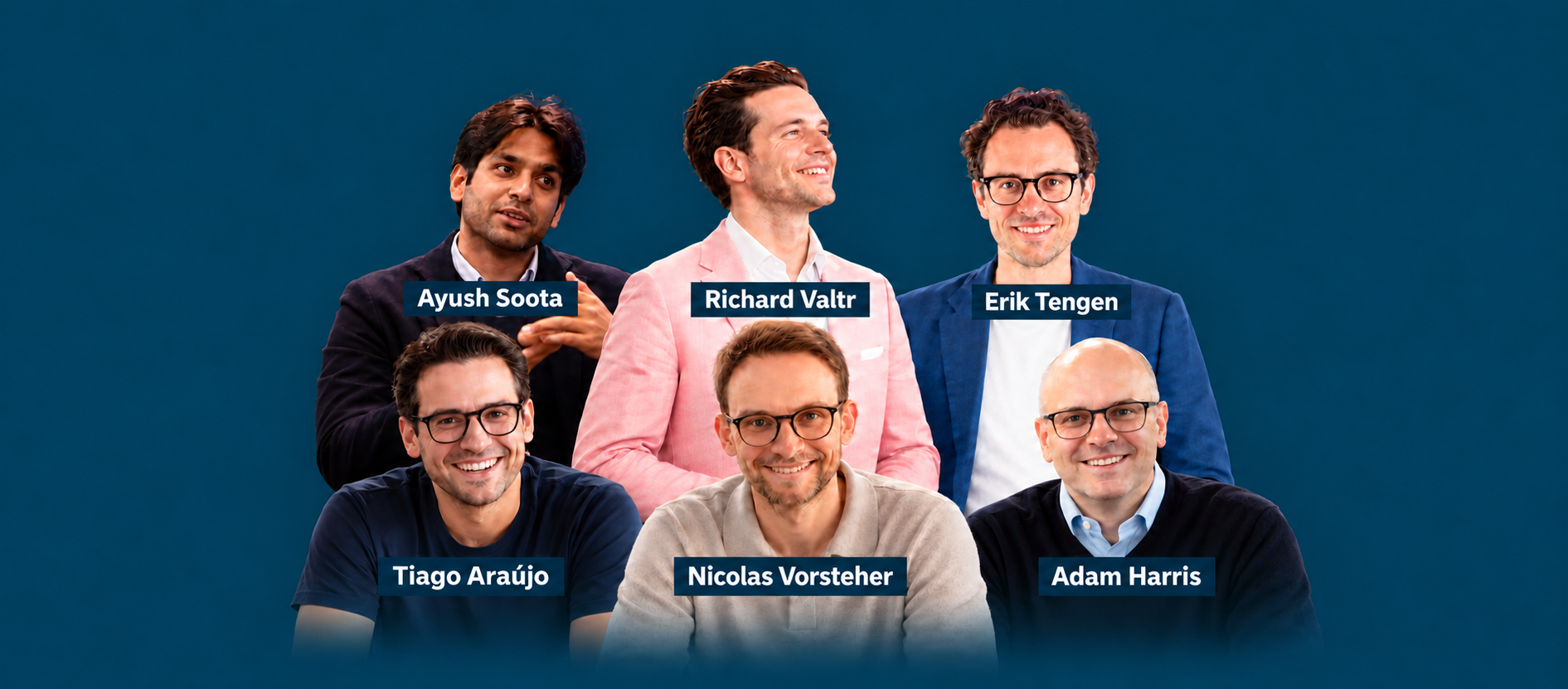
A LinkedIn graphic grouped six founders as the people “building the tech behind top hotels”. The list is a fair one. More useful is what the six are actually betting on, because between them they describe how the hotel software stack is being rebuilt around AI, and where the industry’s two loudest voices on the subject disagree.
The list was posted on 13 October by Thibault Selderslagh, founder of the digital strategy consultancy For Digital Sakes. It names Richard Valtr of Mews, Adam Harris of Cloudbeds, Erik Tengen of Oaky, Tiago Araújo of HiJiffy, Nicolas Vorsteher of chatlyn and Ayush Soota of Paathz. Read together, their companies cover the property management core, revenue, guest communication and the people who do the work. Read against the news of the past year, they also set out an argument about how fast hotels should move.
The argument: move first, or test first
Valtr, who founded Amsterdam-based Mews, made the case for moving first in July. Six months after Mews raised $300 million in a Series D round at a $2.5 billion valuation, the company cut about 15 per cent of a workforce of roughly 1,350, its largest restructuring since the pandemic. Valtr called the decision difficult and said Mews, which serves more than 15,000 hotels in 85 countries, was acting before AI changed its market rather than after. “A singular employee can do so, so much more with AI,” he told Skift, adding that this “does impact a number of different roles built for an era that is ceasing to exist.” Customer-facing roles were largely untouched and the company was still advertising 36 open positions.
Harris, co-founder and chief executive of Cloudbeds, is the sceptic in the room, at least about what hotels are currently signing. Writing for Skift in May, he argued that most hotel AI platforms on the market rely on probabilistic models that produce plausible answers in a demo but are not reliable enough to run daily operations. What hotels need, he said, is deterministic AI that can be trusted to act, whether that is repricing a room, issuing a refund or moving a reservation. His warning to owners signing multi-year contracts now was blunt: those platforms could look like fax machines by 2029. He also expects guest-side AI agents to start negotiating against hotels’ operator-side systems, which raises the stakes for getting the operator side right.
The two positions are not as far apart as they sound. Valtr’s own view of where humans belong in a hotel is “everywhere”. Asked by Hotel Dive in June whether hotels should swap receptionists for chatbots, he answered with a question of his own: “Are you really going to have a chatbot instead of a receptionist?” A Mews survey found 59 per cent of hoteliers believe some experiences, including the front desk and check-in, should stay human-led, and that the hoteliers most comfortable with AI placed the most value on human contact.
What each founder is building
Richard Valtr, Mews: the operating system
Mews began as a cloud property management system and now wants to be more than that. At the company’s Unfold forum this year, 57 per cent of attendees said at the start that they did not want Mews to go beyond PMS functions. After it presented its SiteMinder distribution partnership and what it calls an operating system for hotels, 81 per cent said that was what they wanted. Valtr’s interest in AI is less about revenue than about knowing guests without “sending a 20-page survey”, learning instead from “the whispers and signals”. Matthijs Welle is chief executive; Valtr remains founder.
Adam Harris, Cloudbeds: the platform that acts
Cloudbeds, founded in 2012 and run from San Diego, says tens of thousands of properties in more than 150 countries use its platform. Its spring 2026 release in June added group and events sales, a module for meeting rooms and other rentable spaces, a rebuilt calendar, accounting with USALI-aligned reporting, and an early look at Ask Signals, a conversational interface over its Signals data layer. “Hoteliers got into this business to take care of people, not to wrestle with their hotel tech stack,” Harris said at the launch. The deterministic AI he argues for is, not coincidentally, the kind Cloudbeds says it is building.
Erik Tengen, Oaky: upselling as a revenue discipline
Oaky was founded in 2013 by Tengen, Lars Jonker and Tako Paddenburg, and started life as a real-time guest feedback tool. It pivoted to upselling in 2017 because feedback tools were hard to sell when they produced little measurable return. The company now sells automated, personalised upselling across the guest journey to hotel chains and revenue teams. Its partnership with Duetto links upgrade prices to a property’s rate strategy; in a pilot at two H-Hotels properties in Hamburg and Dresden, spend per upgraded night rose 45 per cent. “Together with Duetto we can extend the dynamic pricing strategy to upselling,” Tengen said at the time. Oaky also feeds offers into HiJiffy’s messaging channels, which connects two names on this list.
Tiago Araújo, HiJiffy: conversation, with a human sign-off
HiJiffy, founded in 2016 and headquartered in Vidigueira, Portugal, with offices in Lisbon and Porto, builds conversational AI for hotels and says it has served more than 2,100 properties. On 16 October it launched Email Copilot, which drafts replies for reservations and front desk teams as guest emails arrive, matching each request against answer templates and the hotel’s knowledge base. The send button stays locked until any missing information is resolved, and every sent email is labelled as AI-generated. The problem it targets is measurable: an EmailAnalytics study of 27.7 million emails in the first quarter of 2026 found hotel teams reply within about four hours 50 minutes during working hours, while guests in practice wait almost 15 hours. “We didn’t build Email Copilot to replace the reservations team,” Araújo said. “The AI handles the first draft; the final call is always human.”
Nicolas Vorsteher, chatlyn: one inbox for every channel
Vorsteher is a repeat founder. He built the recruiting software company Prescreen and sold it to Burda Media’s Xing in 2017, then spent a decade installing hotel software, by his own account in more than 500 properties. chatlyn, which he co-founded in Vienna in late 2022 with Michael Urbanek as chief technology officer and Matthias Haubner as chief product officer, unifies guest messaging across more than ten channels including email, WhatsApp, SMS, web chat and social media, with real-time translation in more than 35 languages and integrations into property management systems. In June 2025 it raised an €8 million Series A led by Smedvig Ventures, with AnyDesk angel Andreas Burike, Austrian transport group Blaguss and investor Mathias Hiebeler among the participants. It says more than 1,000 properties in 30 countries use it, including the St Regis Mauritius and the InterContinental Vienna.
Ayush Soota, Paathz: the people layer
Soota is the one founder on the list whose product is not aimed at guests. A Glion graduate who began in luxury operations at Mandarin Oriental and Four Seasons, he co-founded Paathz, a hiring platform for hospitality that uses AI to structure and match candidate data. More than 30,000 hospitality professionals joined before a single role was posted; by the time the employer beta opened at the end of July across Indonesia, Singapore, the Philippines, Thailand, Malaysia, Spain and Switzerland, the figure had passed 40,000. Joining is free for professionals, final hiring decisions stay with employers, and the platform does not independently verify candidate claims. Soota’s framing of the industry’s staffing problem is that it is not a shortage but a visibility problem: “What is often missing is the infrastructure that allows employers to see that talent clearly.”
What this means for operators
Three things stand out. First, the vendors building the core (Mews, Cloudbeds) are both reorganising around AI, but on different theories of what AI is ready to do. Second, the companies at the guest-facing edge (HiJiffy, chatlyn, Oaky) are converging on the same promise: handle the first draft, the first offer or the first reply automatically, and leave the decision with a person. Third, the labour problem is finally getting its own technology rather than being treated as a by-product of everything else.
For a general manager or owner weighing a contract, the questions that follow from this group are practical ones:
- When the system acts (a price change, a refund, a reservation move), is the action deterministic and auditable, or a model’s best guess?
- Where is the human sign-off, and can it be enforced rather than merely recommended?
- Which guest channels does the system own end to end, and which does it hand off?
- What happens to the data the system learns from your guests if you leave?
- How many of the vendor’s own roles has it rebuilt around AI, and what did that do to support?
The six founders would answer those questions differently. That is precisely why the list is worth reading as an argument rather than a roll of honour.
Sources
- Skift, 7 July 2026: Mews cuts 15% of staff, points to AI in broad restructuring
- Hotel Dive, 8 July 2026: Mews lays off 15% of staff in pivot to AI-native future
- Hotel Dive, 11 June 2026: Mews founder on how AI can deepen human connection at hotels
- Skift, 28 May 2026: Adam Harris on the AI decisions hotel CEOs are signing now
- Cloudbeds, 2 June 2026: Spring Release 2026
- Revfine: Interview with Erik Tengen of Oaky
- Lodging, 2 May 2022: Duetto and Oaky announce a strategic partnership
- Hotel Tech Report, 29 June 2022: Oaky and HiJiffy release integration
- Hotel Speak, 16 October 2026: HiJiffy launches Email Copilot
- Hotel Tech Report, 24 June 2025: chatlyn secures €8m Series A
- Travel Tech Show: Nicolas Vorsteher speaker profile
- Hospitality Net, 30 July 2026: Paathz opens for beta
- Hospitality Net: Ayush Soota author profile